
Wheat sales/allocations from FCI to various schemes reduced/ एफसीआई से विभिन्न स्कीम में गेहूं की बिक्री/आवंटन घटा
19-Nov-2024 09:53 AM
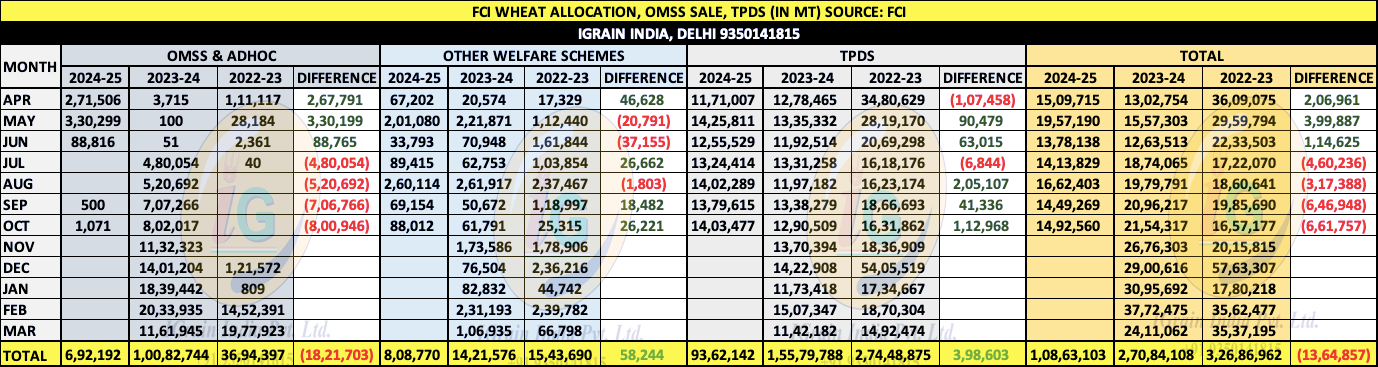
एफसीआई से विभिन्न स्कीम में गेहूं की बिक्री/आवंटन घटा
★ 2024-25 सीजन में अप्रैल से अक्टूबर तक 108.63 लाख टन गेहूं का बिक्री/आवंटन विभिन्न स्कीम में किया गया जो गत वर्ष 122.27 लाख टन और 2022-23 में 160.27 लाख टन था यानी इन 7 महीनों में गत वर्ष से गेहूं की बिक्री/आवंटन 13.64 लाख टन और 2022-23 की समानअवधि से 51.64 लाख टन घटा।
★ जानकारी के लिए बता दें कि 2023-24 में 277.84 लाख टन व 2022-23 326.82 लाख टन गेहूं बिक्री/आवंटन किया गया था।
★ उपरोक्त आकड़ों के अनुसार कमजोर स्टॉक को देख बिक्री/आवंटन में आई गिरावट।
~~~~~~~~~~~~~~~~~~~~~~~~~
Wheat sales/allocations from FCI to various schemes reduced
The reduction in wheat sales/allocations from the Food Corporation of India (FCI) for the 2024-25 season, as compared to the previous years, can be attributed to a weaker wheat stock. Here's a breakdown of the situation based on the figures you provided:
Key Figures:
Wheat Sales/Allocations (April to October) for 2024-25:
108.63 lakh tonnes
Reduction from 2023-24 (April to October): 13.64 lakh tonnes (from 122.27 lakh tonnes)
Reduction from 2022-23 (April to October): 51.64 lakh tonnes (from 160.27 lakh tonnes)
Total Wheat Sales/Allocations for Full Seasons:
2023-24: 277.84 lakh tonnes
2022-23: 326.82 lakh tonnes
Key Insights:
Decline in Wheat Allocations: The decrease in wheat sales/allocations during the first seven months of 2024-25 compared to the previous two years suggests that the FCI's wheat stock may be weaker than in previous years, potentially due to factors like lower procurement or poor harvests.
Impact of Lower Stock: A weaker stock could lead to a reduction in the quantity of wheat available for distribution under various government schemes, including the Public Distribution System (PDS), which could potentially affect food security programs, particularly in states that rely heavily on these allocations.
Stock Management: This reduced allocation may also indicate the FCI’s attempt to manage its stocks carefully, possibly in anticipation of future procurement and to avoid a situation where stocks deplete prematurely.
This situation underscores the importance of monitoring wheat procurement and stock levels, particularly in light of potential risks like climate conditions, which could further strain food security programs.