
Urad – Market Trend 2025
31-Dec-2025 01:48 PM
Urad – Market Trend 2025
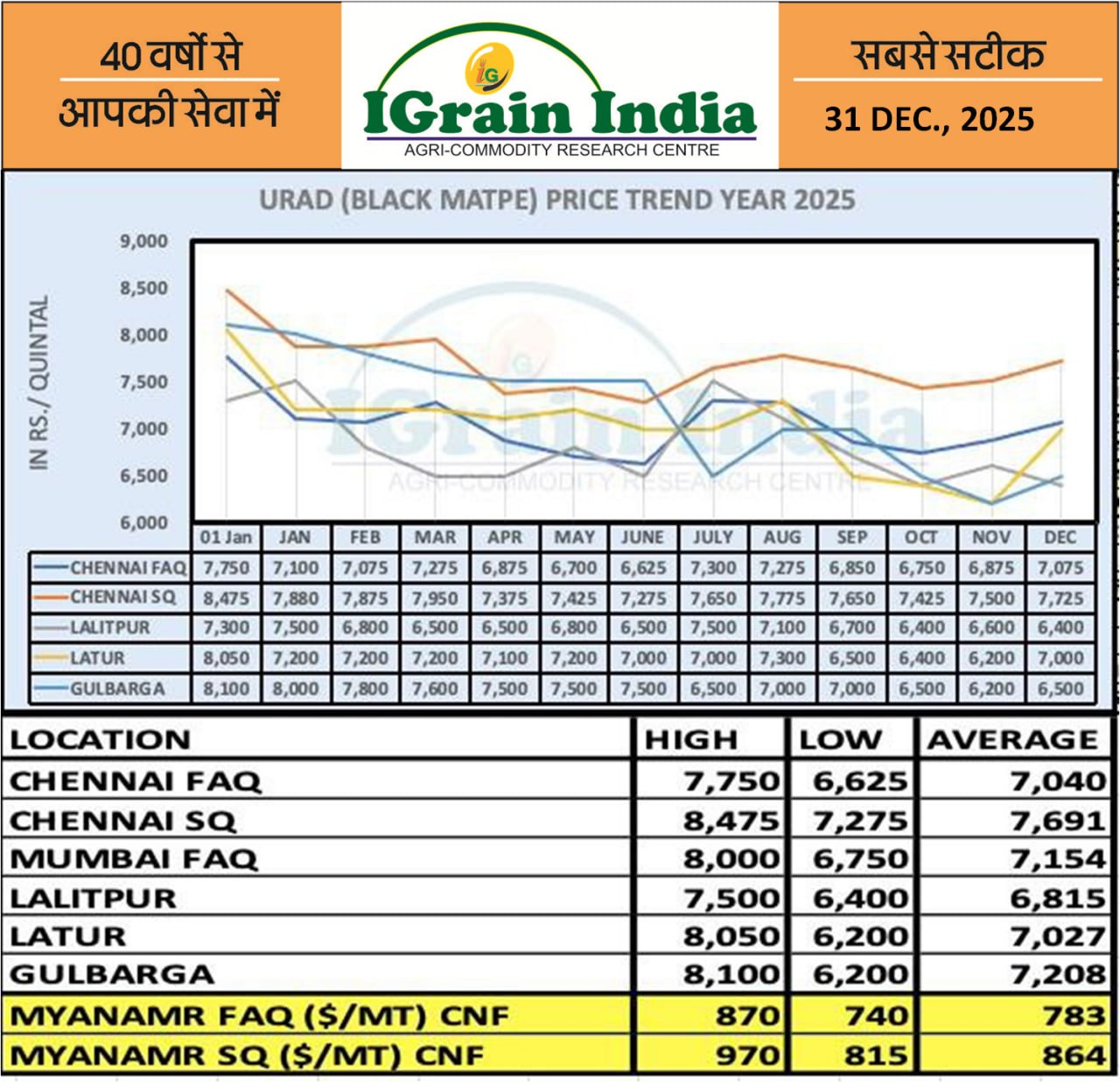
★ During 2025, prices in the domestic urad markets remained within a narrow range, with no major volatility seen through the year. Prices started the year on a relatively firm note in January; however, during February–March, increased imports put mild pressure on the market. In April–May, prices remained largely stable as supply and demand stayed balanced.
★ During June–July, improvement in domestic consumption and a decline in available stocks supported a marginal strengthening in urad prices. However, cautious buying and fresh arrivals during August–September led to some softness in the market. From October to December, prices again moved in a stable to slightly firm trend.
★ According to market data, Chennai FAQ urad recorded a yearly high of ₹7,750 and a low of ₹6,625, with an annual average of ₹7,040. Chennai SQ prices ranged between ₹8,475 and ₹7,275, averaging ₹7,691. Mumbai FAQ urad traded between a high of ₹8,000 and a low of ₹6,750, with an average of ₹7,154.
★ In other major markets, Lalitpur recorded a high of ₹7,500 and a low of ₹6,400, with an average of ₹6,815. Latur prices ranged from ₹8,050 to ₹6,200, averaging ₹7,027. Gulbarga saw a yearly high of ₹8,100 and a low of ₹6,200, with an average price of ₹7,208.
★ In the international market, urad CNF prices also traded within a limited range. Myanmar FAQ urad CNF prices moved between $740 and $870 per tonne during the year, with an average of $783. Meanwhile, Myanmar SQ urad CNF prices fluctuated between $815 and $970 per tonne, averaging $864.
★ Overall, the urad market remained balanced in 2025. Normal demand and adequate supply ensured price stability throughout the year, with the market largely confined to a defined trading band.
~~~~~
Outlook for 2026
★ Among pulses, urad was the only crop whose imports increased during the April–October period compared to the previous year. In the current season, kharif urad production in India declined, while production increased in overseas markets.
★ The urad market remains highly dependent on international supplies. In Myanmar, farmers shifted acreage away from urad toward moong, as moong prices stayed at elevated levels throughout the year.
★ Considering these factors, urad prices are expected to remain firm, with a positive bias and potential upside in the coming period.
Important Disclaimer:
This report is for informational purposes only I-Grain India does not take any responsibility for profits or losses and does not promote any specific market movement (bullish or bearish). *Please make decisions based on your own judgment and understanding.