
The Monsoon's Eastward Progression
13-Jun-2026 11:09 AM
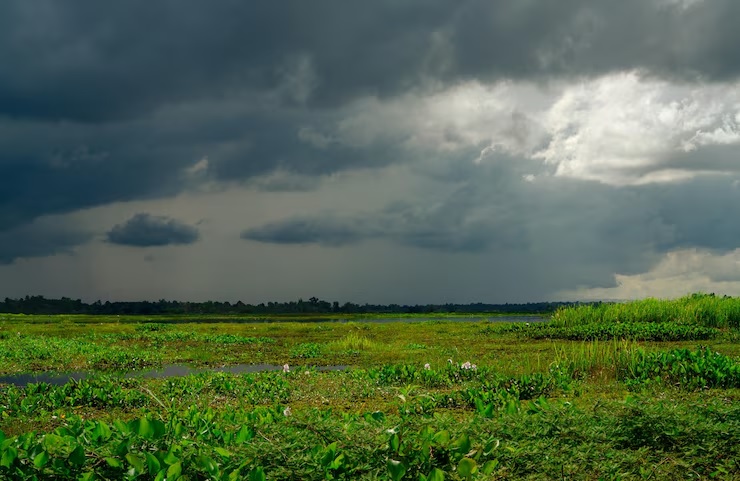
Typically, after reaching the southern coast of Kerala and remaining active over South India for a few days, the Southwest Monsoon splits into two branches. One branch moves towards Eastern and Northeastern India, while the other advances along the western coast towards North India.
This allows the monsoon to cover the entire country on schedule. However, while the monsoon's eastward progression is currently robust—with active conditions in Eastern and Northeastern India—its westward movement appears sluggish. This has naturally caused concern among farmers and the government.
According to the Meteorological Department, heavy rainfall is occurring in the sub-Himalayan region of West Bengal and Sikkim, with similar heavy rains expected in adjacent areas.
It is worth noting that, in terms of agricultural output, the Northeastern states are often considered less significant compared to other parts of the country; however, Eastern Indian states—specifically West Bengal, Bihar, Assam, Jharkhand, and Odisha—engage in large-scale cultivation of paddy and other Kharif crops.
Meanwhile, Western India (Maharashtra, Gujarat, and Rajasthan) and the central and northern regions (Madhya Pradesh, Chhattisgarh, and Uttar Pradesh) are major producers of pulses, oilseeds, sugarcane, cotton, and coarse cereals. Uttar Pradesh, Chhattisgarh, and Madhya Pradesh also record massive paddy yields.
These states are currently awaiting monsoon rains. Last year, the monsoon arrived ahead of schedule in most states, greatly aiding farmers in the early sowing of Kharif crops; this year, however, the monsoon is expected to arrive late and remain somewhat weak. El Niño has emerged in the Pacific Ocean.