
Madhya Pradesh Kharif Area Hits 139.87 Lakh Hectares
11-Sep-2025 06:22 PM
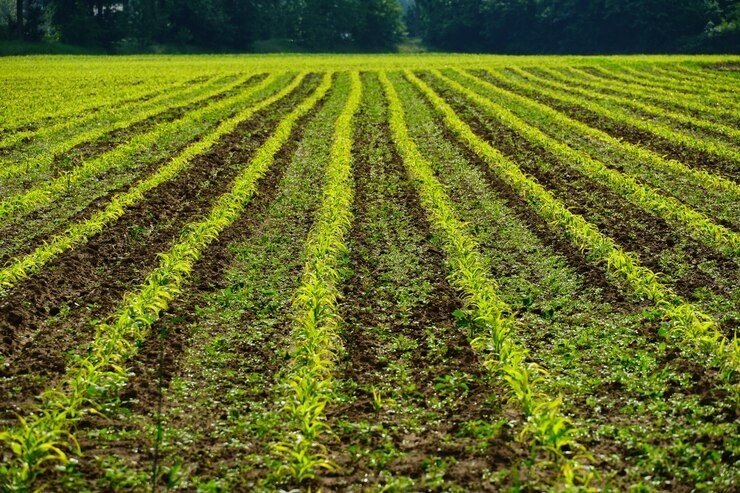
Bhopal. In Madhya Pradesh, a major agricultural producing state of the country, there has been a good increase in the production area of some crops in the Kharif season as compared to last year, while the sowing area of some other crops has also declined.
According to the latest data of the State Agriculture Department, the total production area of Kharif crops in Madhya Pradesh reached 139.87 lakh hectares this time, which is about 1 percent less than the sowing area of 141.32 lakh hectares in the same period last year, but is more than the five-year average area of 136 lakh hectares. This is the sowing figure till 5 September 2025.
According to official data, during the current Kharif season of 2025-26 as compared to 2024-25, the production area of soybean in Madhya Pradesh has fallen from 53.88 lakh hectares to 51.20 lakh hectares, paddy area slipped from 36.33 lakh hectares to 36.20 lakh hectares,
cotton sowing area fell from 6.15 lakh hectares to 5.56 lakh hectares, groundnut area slipped from 6.39 lakh hectares to 4.03 lakh hectares,
millet sowing area fell from 2.87 lakh hectares to 2.37 lakh hectares, sesame area fell from 3.30 lakh hectares to 2.27 lakh hectares, sorghum area slipped from 1.02 lakh hectares to 90 thousand hectares and moong area fell from 1.22 lakh hectares to 95 thousand hectares, while sowing of most of the crops has almost ended.
On the other hand, there has been a good increase in the sowing of some crops in Madhya Pradesh. Under this, the production area of maize jumped from 20.77 lakh hectares to 23.50 lakh hectares,
the area of black gram increased from 4.24 lakh hectares to 5.95 lakh hectares, the sowing area of pigeon pea improved from 3 lakh hectares to 3.36 lakh hectares, the area of sugarcane improved from 1.02 lakh hectares to 1.11 lakh hectares and the area of Niger seed jumped from 19 thousand hectares to 32 thousand hectares.
It is worth mentioning that Madhya Pradesh is the most prominent producer of maize, soybean, black gram and Niger seed, while other crops are also produced there on a large scale.