
Sharp fall in chana prices: Record imports and global pressure to blame
05-Jul-2025 01:58 PM
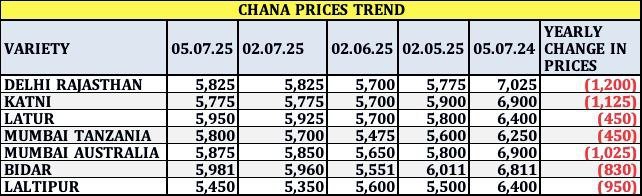
Sharp fall in chana prices: Record imports and global pressure to blame
★ Compared to last year, chana prices have witnessed a significant decline this year. The average mandi price has dropped from ₹6,400 per quintal to ₹5,450 per quintal — a fall of ₹950. Rajasthan and Desi varieties have seen the steepest yearly declines of ₹1,200 and ₹1,125 per quintal, respectively.
~~~~~~~~
Record imports the primary reason for price crash
★ In FY 2024–25, India imported a record 15.06 lakh tons of chana, a massive jump from just 1.64 lakh tons in FY 2023–24 and 0.59 lakh tons in FY 2022–23. This surge in imports has put tremendous pressure on the domestic chana market.
~~~~~~~~
Australia emerges as major supplier
★ The Indian government's decision to allow chana imports just before the sowing season in Australia provided a ready market for ★ Australian farmers. Australia produced over 20 lakh tons of chana last year, strengthening its export capacity. Sowing is currently underway, and import permissions remain valid until 31 March 2026.
~~~~~~~
Yellow pea imports reduce chana consumption
★ Heavy imports of yellow peas into India have also contributed significantly to reduced consumption of chana, as processors and buyers shifted preferences.
~~~~~~~
Upcoming African and Australian crops to add further pressure
★ Fresh crops from Africa are expected in September 2025, followed by Australia’s new harvest in October 2025. These upcoming supplies are likely to keep further pressure on prices in the coming months.
~~~~~~~~
Domestic farmers and industry under stress while global exporters celebrate
★ While overseas farmers and exporters are riding high, Indian farmers and the domestic pulses industry are facing rising stress. The chana market, which earlier moved on actual demand and supply dynamics, is now heavily dictated by international developments — making it difficult for local producers to remain competitive.
★ Though some price recovery was noted in the last month due to improved domestic demand and declining Australian stock, data from the table shows how deeply the market is now dependent on global factors.
★ Upcoming festive demand and reduced imports may offer some support to chana prices by September–October 2025.