
Africa's Pigeon Pea (Tuar) Production and Trade: Key Highlights from the Last Three Years (2023–2025)
15-Jul-2025 12:19 PM
Africa's Pigeon Pea (Tuar) Production and Trade: Key Highlights from the Last Three Years (2023–2025)
Impact on India
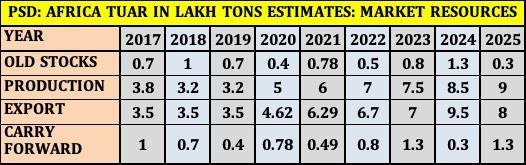
★ Driven by steadily rising demand from India, Africa’s pigeon pea production is expected to reach 9 lakh tons in 2025—an increase of 1.5 lakh tons compared to 2023.
★ Production has been increasing every year.
★ In 2024, Africa recorded a historic export of 9.5 lakh tons of pigeon peas, but exports may decline to 8 lakh tons in 2025.
★ India had a good harvest and substantial imports last year, resulting in healthy domestic stock levels, while Myanmar also reported strong production and steady supply.
★ Opening stocks in Africa rose from 0.8 lakh tons in 2023 to 1.3 lakh tons in 2024 but are projected to fall sharply to just 0.3 lakh tons in 2025 due to rising exports over two years.
★ By the end of 2025, closing stocks are expected to remain at 1.3 lakh tons.
★ In April 2025, India imported 55,420 tons from African nations, 43,625 tons from Myanmar, and a total of 99,546 tons including other countries.
★ According to OATA, Myanmar exported 1.82 lakh tons of pigeon peas between January and July 2025.
★ Prices of Myanmar lemon pigeon peas dropped from $1,465/ton in June 2024 to the $720 range—mirroring similar trends in the Indian market.
★ These figures clearly show that India’s reliance on imported pigeon peas is steadily increasing, and this is visibly impacting domestic markets
★ New African pigeon peas are expected to arrive starting in September, and until then, the demand may shift to existing domestic stocks, possibly supporting prices.
★ Lower prices have led to a reduction in pigeon pea sowing, and insufficient rainfall in districts near the Maharashtra-Karnataka border has led to low soil moisture, which may affect the crop.
★ In the longer term, the situation will become clearer over the next 20 days as sowing data and monsoon progress emerge.