
Kharif crop sowing has fluctuated compared to last year
08-Oct-2025 01:49 PM
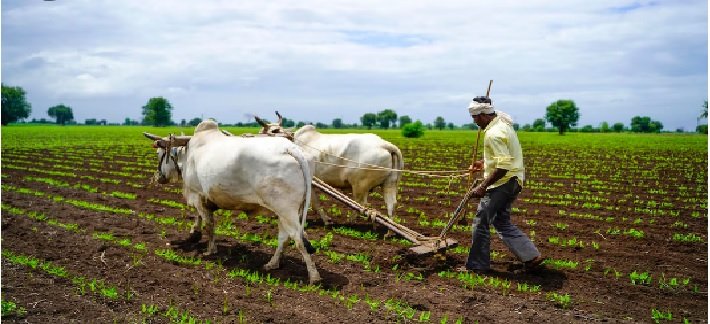
New Delhi. This year, the area under Kharif crops has increased by 6.51 lakh hectares from 1114.95 lakh hectares to 1121.46 lakh hectares, significantly higher than the normal average area of 1096.65 lakh hectares.
During the all-time period, the area under paddy, black gram, maize, and sugarcane has increased significantly, but the area under soybean, groundnut, and cotton has decreased. Sesame acreage remained low, while castor acreage increased.
Other Kharif crops, including sorghum, millet, ragi, tuvar, green gram, moth bean, and sunflower, have seen minor increases in their area under cultivation.
Compared to last year, this time the area under paddy production increased from 435.68 lakh hectares to 441.58 lakh hectares, the area under black gram improved from 22.87 lakh hectares to 24.37 lakh hectares, the area under maize jumped from 84.30 lakh hectares to 94.95 lakh hectares and the area under sugarcane improved from 57.22 lakh hectares to 59.07 lakh hectares.
On the other hand, the area under soybean production declined from 129.55 lakh hectares to 120.45 lakh hectares, the area under cotton declined from 112.97 lakh hectares to 110.03 lakh hectares and the area under groundnut declined from 49.96 lakh hectares to 48.36 lakh hectares during the same period.
Some fluctuations were also seen in the area under other Kharif crops. Southwest monsoon rainfall from June 1 to September 30, 2025, was 8 percent above the long-term average.
This year, northwestern India and the central western region received exceptionally heavy rainfall. Peninsular South India also received approximately 7 percent more rainfall than the normal average during this period, while eastern and northeastern regions experienced 20 percent less rainfall.
The uneven distribution of rainfall has damaged Kharif crops in some areas, and production is expected to decline there. Crop conditions in other areas are reported to be satisfactory.
New arrivals have begun in markets, and the pace will gradually increase in the coming days. The condition of pulses and oilseeds crops needs to be monitored.