
Soyabean Survey Report: SOPA
13-Aug-2025 05:17 PM
Soyabean Survey Report: SOPA
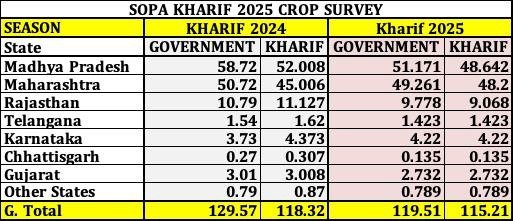
★ SOPA conducted its first comprehensive area and health survey of the Kharif 2025 soybean crop from 4 August 2025 to 9 August 2025. Two teams covered 38 districts across three states, travelling approximately 4,200 kilometres and surveying a total area of 89 lakh hectares. This included 46.6 lakh hectares in 22 districts of Madhya Pradesh, 34.9 lakh hectares in 11 districts of Maharashtra, and 7.5 lakh hectares in 5 districts of Rajasthan.
~~~~~~~~~~
★ The survey found that the soybean sown area this year is lower by 3.110 lakh hectares, or 2.63 percent, compared to last year. The main reasons are a shift to other crops and failure to sow due to continuous rainfall during the sowing period. About 70 percent of the crop is at the flowering stage, and overall crop condition is normal. Most fields are free from weeds and major pest infestations. Some areas reported stem fly infestation, which has been successfully controlled with insecticides. Localised issues such as late sowing, waterlogging, and weed pressure were also observed.
~~~~~~~
Maharashtra
★ In Jalna, Buldhana, Beed, Latur, Hingoli, Nanded, and Parbhani districts, the crop is healthy with normal growth. Parts of Washim, Akola, Hingoli, and Amravati showed delayed sowing or resowing, along with shorter plant height.
~~~~~~
Madhya Pradesh
★ In the Malwa region, about 70 percent of the crop is in the flowering stage, with overall normal condition. The districts of Ashoknagar, Guna, Harda, Betul, Khandwa, and Khargone have seen a reduction in sown area compared to last year. In Harda district, continuous rainfall led to 20 percent of the area remaining unsown, with weak plant growth and heavy weed infestation. In lowland areas of Ashoknagar, Guna, Sagar, and Vidisha, persistent rainfall caused waterlogging, stunted growth, poor vegetative development, and weed presence.
~~~~~~
Rajasthan
★ In Pratapgarh, Chittorgarh, and Baran districts, the crop condition is average, with 70 percent of the area in the flowering stage. In Jhalawar, continuous rainfall prevented sowing in 20 percent of the area. In Kota and Jhalawar, waterlogging from excessive rain resulted in poor vegetative growth, short plants, and weed infestation.
~~~~~~~~
All India
★ Overall, the soybean crop condition is satisfactory, particularly in Maharashtra and parts of Madhya Pradesh. However, excessive rainfall has caused unsown areas, delayed growth, and waterlogging in some regions. Continued monitoring and timely crop management will be crucial during the remaining stages of growth.