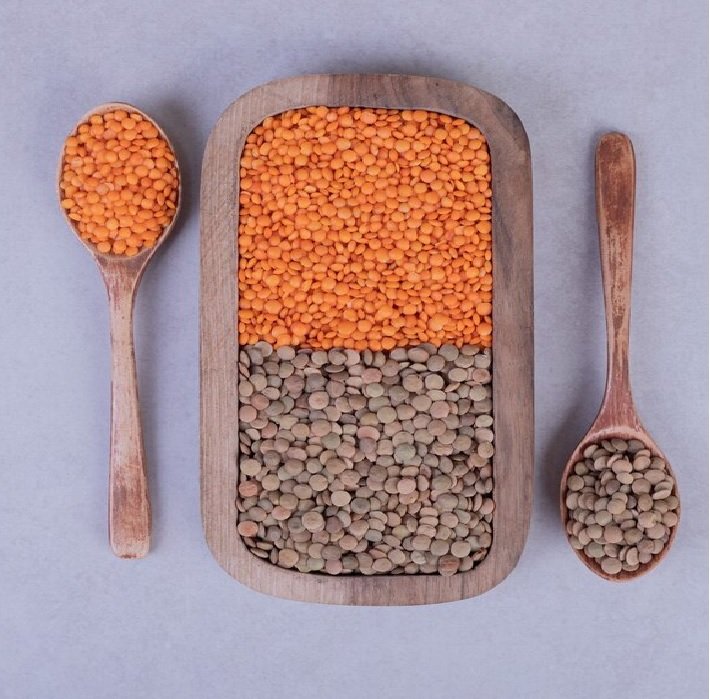
Masoor prices continue to decline amid heavy imported stocks and increased sowing; prospects for a significant rally remain weak.
Domestic Masoor prices continued to trend downward this week, driven by mounting selling pressure and sluggish demand. Limited procurement by pulse mills, combined with ample availability of imported Masoor at ports, has exerted downward pressure on both imported and domestic varieties. A steady influx of new shipments has kept domestic supply levels robust. Furthermore, sowing for the current Rabi season is progressing at a faster pace compared to last year. According to government data, Masoor has been sown across 1.439 million hectares—an increase of 0.3 million hectares over the same period last year. This expansion in the sown area points toward a potential rise in the upcoming harvest, though the final output will ultimately depend on weather conditions and crop yields. Meanwhile, substantial stocks of imported Masoor remain at the ports, and the continuous arrival of new shipments ensures that supply-side pressure persists. As imported Masoor is relatively cheaper, pulse mills are showing a stronger preference for it over domestic produce, which further weighs on the prices of domestic Masoor. On the global front, higher production forecasts for Australia and Canada suggest that international supply will remain strong—a factor that is influencing sentiment in the domestic market. Due to increased selling by importers and weak buying interest, prices for imported Masoor have fallen by approximately ₹150–300 per quintal. At the Mundra port, prices for masoor (lentils) stood at ₹5,500–₹5,525 per quintal, while at Hazira, they were ₹5,550 per quintal. In Mumbai, Canadian masoor (available via container) was priced at ₹5,900 per quintal, and Australian masoor at ₹6,000 per quintal.
Delhi Market
Due to limited buying by pulse millers, prices for 'small' (chhoti) masoor in the Delhi market declined by ₹50 per quintal, while 'large' (badi) indigenous masoor saw a drop of ₹25 per quintal this week. By the end of the week, prices for small masoor stood at ₹6,700–₹6,725 per quintal for the Kota variety, ₹7,400 for the Bundi variety, and ₹7,750–₹7,800 for the Uttar Pradesh variety; large indigenous masoor was priced at ₹6,250–₹6,275 per quintal.
Madhya Pradesh
Sluggish buying in the major producing markets of Madhya Pradesh led to a decline of approximately ₹100–₹200 per quintal in masoor prices. By the end of the week, prices were ₹5,800–₹6,200 in Ashoknagar, ₹5,700–₹6,000 in Bina, ₹5,700–₹6,000 in Ganjbasoda, ₹5,500–₹5,800 in Sagar, ₹5,500–₹6,100 in Damoh, ₹6,000–₹6,100 in Indore, ₹4,851–₹5,755 in Kareli, and ₹6,100–₹6,150 per quintal in Katni.
Uttar Pradesh
Due to persistent weak demand, prices for masoor in Uttar Pradesh saw a decline of ₹100–₹200 per quintal during the current week. Following this decline, by the end of the week, prices for small-grain lentils (masoor) stood at ₹8,600 per quintal and large-grain lentils at ₹6,000 per quintal in Bareilly. In Lalitpur, large-grain lentils were priced at ₹5,400–₹5,450 per quintal, while small-grain lentils were at ₹6,800–₹7,100 per quintal. In Orai, lentil prices reached ₹5,000–₹5,400 per quintal.
Bihar and Other Markets
Due to sluggish demand in Bihar, lentil prices recorded a decline of ₹100 per quintal this week. By the weekend, prices stood at ₹6,600 per quintal in Barh, ₹6,500 in Khusrupur, and ₹6,600 in Mokama. Meanwhile, in Raipur, lentil prices softened by ₹50, settling at ₹6,550 per quintal.
Lentil (Masoor Dal) Market
Reflecting the decline in raw lentil prices and weak consumer demand, prices for *masoor dal* (split lentils) saw a softening of ₹50–₹100 per quintal during the current week. By the weekend, *masoor dal* prices were ₹7,300–₹7,400 per quintal in Indore, ₹7,500–₹7,700 in Barh, ₹7,400–₹7,600 in Khusrupur, ₹7,500–₹7,700 in Mokama, ₹7,700 in Chandausi, and ₹7,550 per quintal in Hyderabad.